
Foundation Matters
Updated: Jun 3
In today’s martial arts world, people are often searching for shortcuts. Fancy techniques, fast drills and complex applications dominate social media feeds, giving the impression that skill is built through variety and speed alone. But in Wing Chun, true ability is forged in the foundations.
The irony is that what most beginners want to rush past is often the very thing that eventually separates skilled practitioners from everyone else.
What Is Foundation Training?
Foundation training refers to the core mechanics and attributes that everything else in Wing Chun is built upon. This includes 3 primary exercises - stance, turns and punches which train:
Structure and body awareness
Balance and stability
Relaxation and body alignment
Body movement mechanics
Speed, timing and coordination
At first glance, these things can appear simple. Even repetitive. But simplicity is deceptive. Inside every fundamental movement are layers of mechanics that take years to refine.
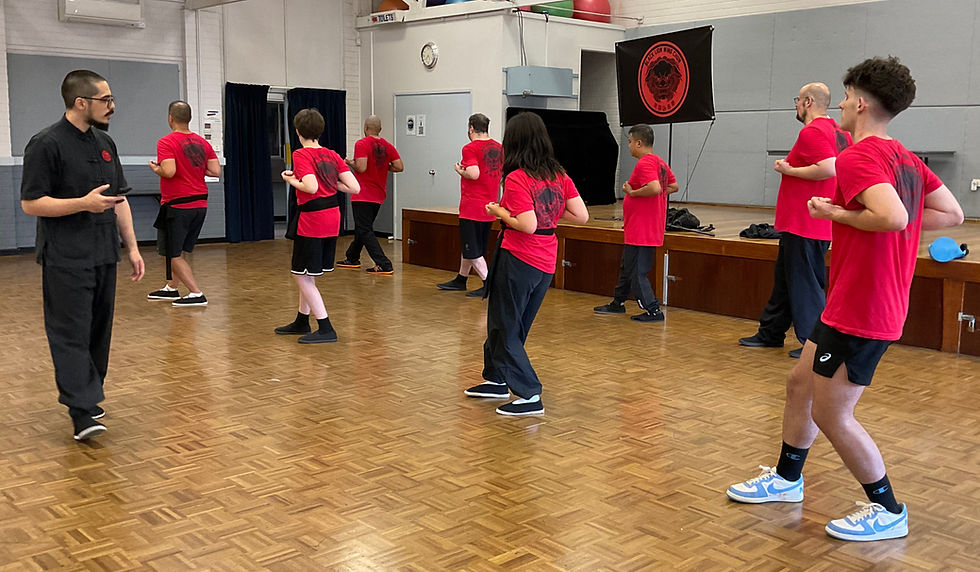
The Difference Between Technique and Skill
Many people collect techniques. Far fewer develop skill.
Without foundation training, techniques are shallow. They rely on speed, strength or cooperation to work, while under stress, they often collapse.
But when the foundations are strong, even the simplest movement becomes difficult to deal with. A straight punch delivered with correct structure, balance, timing and intent can be far more effective than a catalogue of advanced combinations performed without substance. This is why Black Lion Wing Chun places so much emphasis on basics.
Getting Past the Foundation
One of the biggest misconceptions in martial arts is that beginners and advanced students should train completely different things. In reality, advanced practitioners usually spend even more time refining fundamentals, the difference is depth.
A beginner may practice a stance to learn where to place their feet.
An experienced practitioner uses the same stance to refine things like control, alignment, deeper relaxation or stability while moving. They have also been around long enough to appreciate the importance of thorough foundation practice.
It may look the same from the outside, but internally it becomes increasingly sophisticated. Foundation training is not something you “finish.” But rather, something you continually return to.

Building Power Without Tension
One of the major goals of Wing Chun foundation work is learning how to generate force efficiently rather than forcefully. Many people instinctively use muscular tension to create power. This works temporarily, but it slows movement, wastes energy and creates rigidity that can be used against them.
Good foundation training teaches the body to:
Maintain stability while moving
weave the body together into a single unit
transfer force through internal structure
remain relaxed under pressure
develop speed and quality of movement
This allows power to emerge naturally without excessive effort.
Why Is It Often Skipped
Foundation training is demanding in a different way than hard sparring or intense conditioning. It requires patience, attention to detail, resilience and consistency.
Progress can feel slow because it's a transformative process that takes time and effort (Kung fu). Observing our own improvement is like watching our hair grow, we don't notice until it's too long and time for a haircut.
Yet this is also why foundation training produces lasting skill. Anyone can imitate movement for a short time but very few people are willing to spend years refining the qualities underneath.
In Wing Chun, foundations are not the beginning stage of training.
They are the training.

Comments